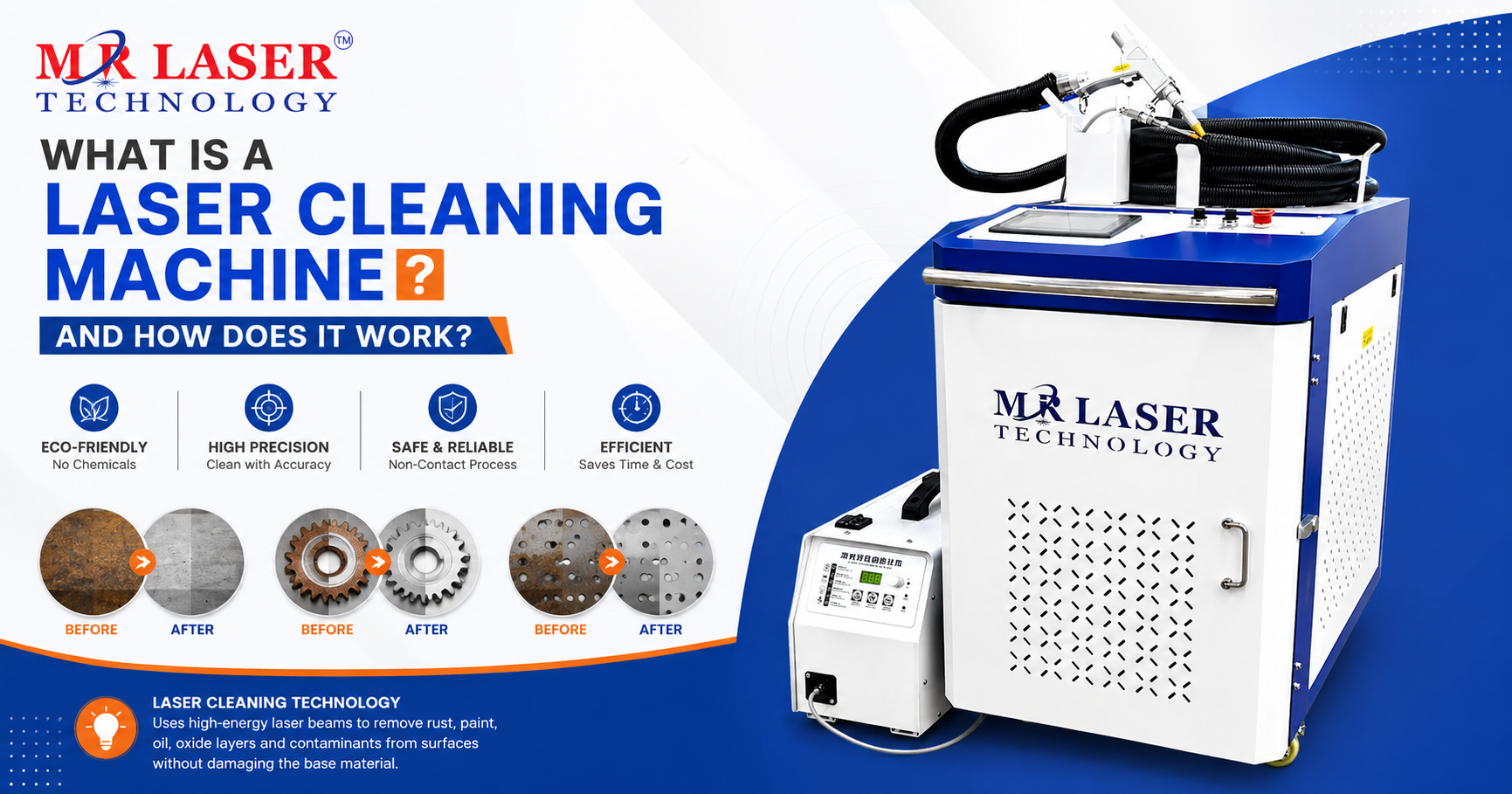
What Is a Laser Cleaning Machine and How Does It Work?
In the realm of industrial manufacturing and maintenance, achieving pristine surfaces is often paramount. Traditional cleaning methods, while effective to a degree, can be time-consuming, labor-intensive, and sometimes even detrimental to the underlying material. Enter the laser cleaning machine, a cutting-edge solution that leverages the power of focused light to remove contaminants with unparalleled precision and efficiency.
MR Laser Technology, a manufacturer of industrial laser and CNC machines, understands the growing demand for advanced surface treatment solutions. Their expertise in laser technology allows them to offer sophisticated machinery designed for accuracy, speed, and reliability, including solutions like their Hand Held Fiber Laser Cleaning Machine.
Understanding Laser Cleaning Technology
At its core, a laser cleaning machine operates on the principle of laser ablation. This process involves using a high-energy laser beam to precisely vaporize or sublimate unwanted material from a surface. The key to its effectiveness lies in the concept of the ablation threshold. Every material has a specific energy level required to transition from a solid to a gas state. By carefully tuning the laser's energy output, it can be directed to remove surface contaminants—such as rust, paint, oil, grease, or oxides—without affecting the base material underneath. This selective removal ensures that delicate components or precisely engineered surfaces remain unharmed.
The process can be achieved using different types of laser beams, including continuous wave (CW) or pulsed laser beams, each offering distinct advantages depending on the application and the material being treated.
How Does a Laser Cleaning Machine Work?
The mechanism behind a laser cleaning machine is fascinatingly precise. When the laser beam encounters the surface, its energy is absorbed by the contaminants. If this energy exceeds the ablation threshold of the contaminant, it rapidly heats up, turning into a gas or plasma.
- Vaporization & Detachment: The intense heat causes the contaminants to vaporize. The resulting rapid expansion and pressure can also physically detach particles from the surface.
- Non-Contact Process: Unlike abrasive methods, laser cleaning is a non-contact process, eliminating the risk of scratching or damaging the substrate.
- Material Selectivity: The process can be finely controlled. Different materials absorb laser energy differently. By selecting the appropriate laser parameters, the system can target specific contaminants while leaving the underlying material untouched.
- Contaminant Removal: The vaporized contaminants are typically expelled from the area, often aided by an exhaust system, leaving the surface clean.
This controlled interaction ensures that even stubborn residues, such as thick layers of rust or baked-on coatings, can be removed effectively, down to the bare metal if required.
Practical Applications of Laser Cleaning
The versatility and precision of laser cleaning machines make them invaluable across a wide spectrum of industries. Their ability to clean effectively without harsh chemicals or abrasive media opens up new possibilities for surface preparation and maintenance.
Automotive
Removing rust, paint, and gasket residue from engine parts, chassis, and molds without damaging metal components. Ideal for preparing surfaces before welding or painting.
Aerospace & Defense
Cleaning critical components, removing corrosion from aircraft parts, and preparing surfaces for structural bonding or coating, ensuring maximum integrity and safety.
Electronics
Cleaning delicate electronic components, removing flux residues from printed circuit boards (PCBs), and preparing semiconductor surfaces without causing damage.
Manufacturing & Tooling
Cleaning industrial molds, dies, and tools to remove residues and contaminants, restoring their original condition and extending their lifespan.
Art & Restoration
Gently removing layers of paint, grime, or varnish from historical artifacts, sculptures, and artworks, preserving the original material.
Marine
Removing marine growth, rust, and old coatings from ship hulls and offshore structures without generating hazardous waste.
Benefits of Using a Laser Cleaning Machine
The adoption of laser cleaning technology offers significant advantages over conventional methods:
- Environmental Friendliness: It eliminates the need for chemical solvents, reducing hazardous waste and environmental impact.
- High Precision: Allows for targeted cleaning of specific areas, crucial for intricate parts and sensitive surfaces.
- Non-Abrasive: Preserves the integrity and finish of the underlying material, preventing damage or wear.
- Cost-Effectiveness: Reduces consumables, labor, and waste disposal costs over time, despite the initial investment.
- Efficiency and Speed: Laser cleaning can be significantly faster than manual methods, especially for large areas or difficult contaminants.
- Versatility: Applicable to a wide range of materials and contaminants, from delicate electronics to heavy industrial components.
MR Laser Technology emphasizes precision, efficiency, and reliability in its machine solutions, aligning with the core benefits that laser cleaning provides to various industrial processes.
Frequently Asked Questions (FAQ)
● Is laser cleaning safe for all materials?
Laser cleaning is highly selective. While it can remove contaminants without damaging most base materials, it's crucial to select the correct laser parameters for the specific material and contaminant combination to avoid any potential surface alteration.
● Can laser cleaning remove all types of coatings?
Laser cleaning is effective for removing a wide range of coatings, including paint, rust, oil, grease, and oxides. The success depends on the coating's thickness, composition, and adhesion, as well as the laser parameters used.
● How is laser cleaning integrated into industrial processes?
Laser cleaning systems can be standalone units or integrated into automated production lines. They can be controlled manually, mounted on robotic arms for complex geometries, or used with Cartesian systems for precise path movements.
● What is the difference between pulsed and continuous wave lasers for cleaning?
Pulsed lasers deliver energy in short bursts, ideal for removing delicate contaminants or working with sensitive materials, as they minimize heat buildup. Continuous wave (CW) lasers deliver a steady beam and are often used for more demanding tasks like removing thicker layers of material.
Advanced Laser Solutions from MR Laser Technology
For industries seeking to enhance their surface preparation and cleaning processes with cutting-edge technology, a laser cleaning machine offers a powerful, efficient, and environmentally sound solution. MR Laser Technology provides advanced laser and CNC machines, backed by technical expertise and reliable support, to meet diverse industrial needs.
Explore how MR Laser Technology's solutions can bring precision and efficiency to your operations. Discover their range of industrial laser machines designed for performance and reliability.