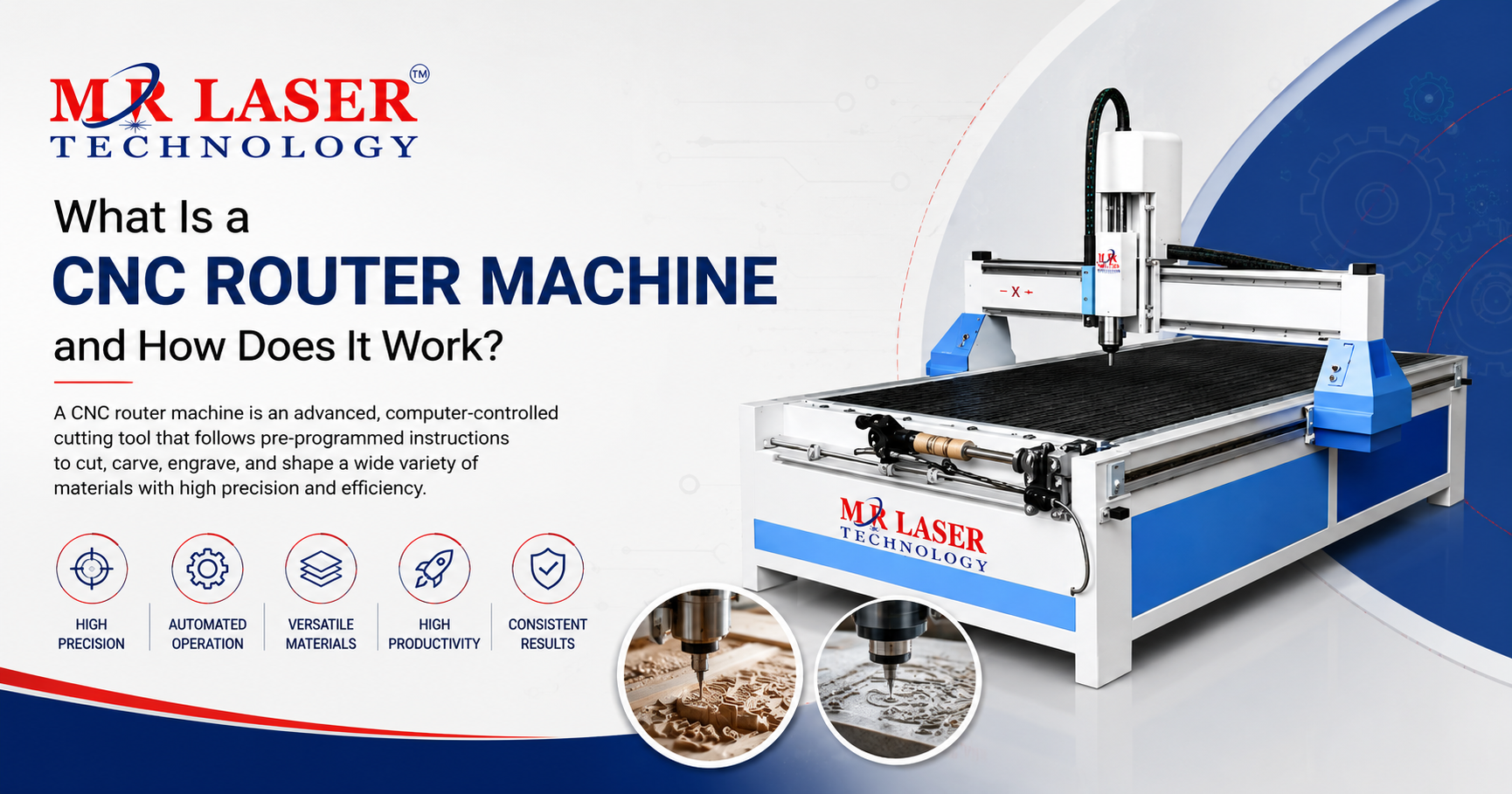
What Is a CNC Router Machine and How Does It Work?
In the realm of modern manufacturing and fabrication, precision, efficiency, and automation are paramount. At the forefront of this technological advancement stands the CNC router machine. More than just a cutting tool, a CNC router is a sophisticated piece of equipment that bridges the gap between digital design and physical creation. This guide delves into what a CNC router machine is, how it functions, and its pivotal role in shaping diverse materials, from intricate wood carvings to robust stone designs.
MR LASER TECHNOLOGY, a leading manufacturer based in Ahmedabad, India, specializes in providing high-precision CNC router solutions for wood and stone. With over 8 years of experience and a commitment to quality, evidenced by their ISO 9001:2015 certification and CE compliance, they offer machines engineered for efficiency, reliability, and superior performance.
Understanding the CNC Router Machine
CNC stands for Computer Numerical Control. A CNC router machine is essentially an automated cutting tool that operates based on pre-programmed computer instructions. Unlike traditional routers operated manually, a CNC router follows digital commands to move a cutting tool (a router bit) along multiple axes (typically X, Y, and Z) with remarkable accuracy. This allows for precise cutting, shaping, carving, engraving, and drilling of a wide variety of materials.
These machines are the digital evolution of traditional routing and shaping tools. They can perform tasks that would otherwise require multiple different machines or extensive manual labor, such as panel sawing, spindle molding, boring, and even cutting complex joinery. The integration of computer control minimizes human error, reduces material waste, and ensures consistent results, making them indispensable for both prototyping and large-scale production.
How a CNC Router Works: The Process
The operation of a CNC router involves a seamless interplay between design software, machine control, and the physical cutting process:
- Design Creation: The process begins with creating a digital design using Computer-Aided Design (CAD) software. This design can be a simple 2D shape or a complex 3D model.
- Toolpath Generation: CAD designs are then imported into Computer-Aided Manufacturing (CAM) software. The CAM software translates the design into specific instructions for the machine, known as G-code. This G-code dictates the path the cutting tool will take, the speed of movement, spindle speed, and other critical parameters.
- Machine Setup: The G-code file is loaded into the CNC router's control system. The operator then secures the workpiece onto the machine's table, installs the appropriate router bit, and sets the machine's origin point.
- Automated Cutting: The CNC controller reads the G-code and sends signals to the machine's motors. These motors precisely control the movement of the cutting tool along the X, Y, and Z axes, removing material according to the programmed path.
- Material Processing: The spinning router bit cuts, carves, or engraves the material, transforming the raw workpiece into the desired finished product. The machine's rigid structure and precise motor control ensure accuracy and repeatability throughout the operation.
Key Components of a CNC Router
Several core components work in harmony to enable the precise operation of a CNC router:
- Spindle: The motor that spins the cutting tool (router bit) at high speeds. It's the heart of the cutting action.
- Cutting Tool (Router Bit): The bit attached to the spindle that physically removes material. Various types of bits are used for different cutting, carving, or engraving tasks.
- Machine Bed/Table: The stable surface onto which the workpiece is secured. Options include vacuum beds for material hold-down or T-slot tables for clamping.
- Drive System: Motors (often stepper or servo motors) and associated components (like ball screws or rack and pinion systems) that translate the controller's commands into precise linear or rotational movement along the axes.
- Control System (Controller): The