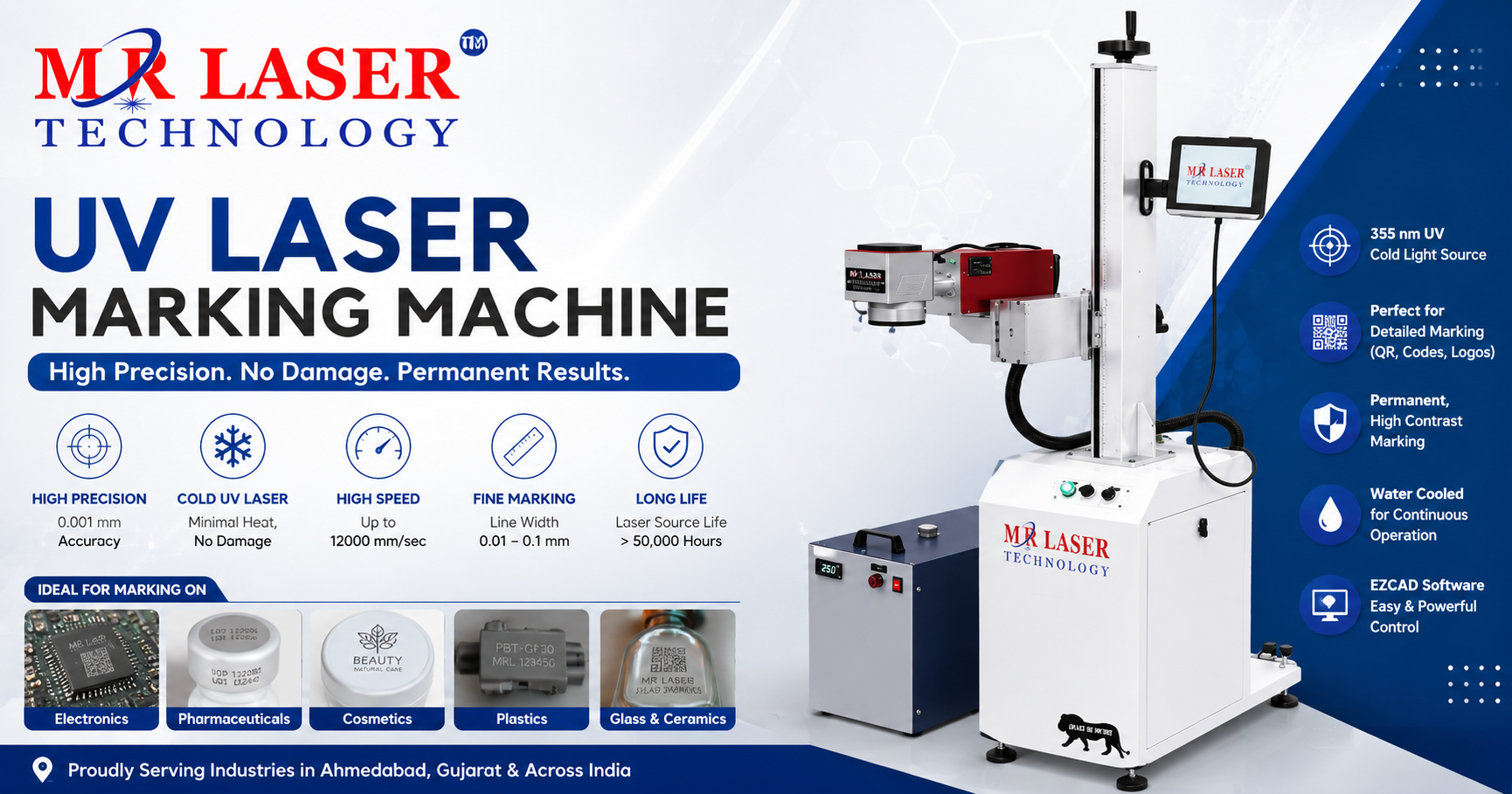
UV Laser Marking mahine
Discover advanced UV laser marking machines in Ahmedabad, Gujarat. Achieve high-precision, damage-free marking on heat-sensitive materials for diverse industria
Why This Matters in Ahmedabad, Gujarat
Ahmedabad, situated in the industrial heartland of Gujarat, is a significant hub for diverse manufacturing sectors, including pharmaceuticals, automotive components, electronics, and fast-moving consumer goods (FMCG). These industries rely heavily on efficient and reliable marking solutions for traceability, brand protection, and regulatory compliance. The demand for advanced UV laser marking machines in this region stems from the need to process a wide array of materials, from sensitive plastics to glass, without compromising product quality or production speed. Local businesses require robust, high-precision equipment to maintain their competitive edge and adhere to global quality standards.
What Is a UV Laser Marking Machine — Overview
A UV laser marking machine utilizes a 355 nm wavelength ultraviolet laser, often referred to as a "cold light source." Unlike fiber or CO2 lasers that rely on thermal processes, UV lasers achieve marking through a photochemical ablation process. This means the laser energy directly breaks molecular bonds in the material, vaporizing it with minimal heat transfer to the surrounding area. This characteristic makes UV lasers ideal for marking materials that are sensitive to heat, preventing issues like burning, melting, or deformation. The result is a clean, sharp, and permanent mark with exceptional detail and contrast.
Key Features and Technical Specifications
355 nm UV cold light source for minimal thermal impact on materials.
High-speed online "fly marking" capability, supporting production speeds up to 12000 mm/sec.
Exceptional marking precision with a repeatable accuracy of 0.001 mm.
Fine beam diameter, enabling marking line widths between 0.01 mm and 0.1 mm for intricate details.
Robust water cooling system ensures stable and continuous operation during extended use.
Versatile marking area options, ranging from 110x110mm up to 300x300mm.
Extended laser source lifetime, typically exceeding 50,000 hours of operation.
Integrated EZCAD software, offering comprehensive control and design flexibility.
Industrial Applications and Use Cases
Marking serial numbers, QR codes, and logos on electronic components, PCBs, and microchips.
Applying traceability codes and expiry dates on medical devices, pharmaceutical packaging, and blister packs.
Branding and batch coding on cosmetics containers, caps, and beauty product packaging.
Permanent identification and part numbering on plastic products, automotive parts, and electrical connectors.
High-contrast marking and etching on glass, ceramics, and silicone components without micro-fractures.
Batch coding and branding on PVC pipes, wire cables, water bottles, and other heat-sensitive packaging materials.
Precision marking on leather goods, paper products, and wooden items for decorative or functional purposes.
Creating fine details on resin components and coated metals where surface integrity is crucial.
How to Choose the Right UV Laser Marking Machine
Selecting the appropriate UV laser marking machine involves evaluating several critical factors to ensure it aligns with specific production needs and material requirements. A careful assessment helps in making an informed investment.
- Laser Power and Wavelength: Match the laser power (e.g., 5W, 10W) and the 355 nm UV wavelength to the specific materials being marked and the desired marking depth.
- Marking Area and Speed: Consider the required marking area and the maximum production speed to ensure the machine can integrate seamlessly into existing lines.
- Material Compatibility: Verify the machine's suitability for heat-sensitive materials like plastics, glass, and delicate electronic components.
- Software Integration and User Interface: Assess the ease of use and capabilities of the control software, such as EZCAD, for design flexibility and operational efficiency.
- Supplier's Technical Support and Training: Ensure the supplier provides comprehensive technical support, installation assistance, and operator training.
- Machine Stability and Component Quality: Evaluate the overall build quality, stability, and the brand reputation of critical components like the laser source and scanning galvanometer.
- Customization Options: Determine if the machine can be customized with features like automated feeding systems or vision inspection for specific production workflows.
Quality Standards and Compliance
Adherence to quality standards and compliance is fundamental when investing in industrial machinery like UV laser marking systems. Manufacturers should ensure their equipment meets relevant international and national standards, such as ISO certifications for quality management systems. For laser products, compliance with IEC (International Electrotechnical Commission) standards, particularly those related to laser safety (e.g., IEC 60825-1), is crucial for operator protection and safe operation. Buyers should verify that the supplier provides documentation of these certifications and conducts rigorous quality control checks throughout the manufacturing process. This commitment to standards ensures the reliability, performance, and safety of the UV laser marking machine in an industrial setting.
Why Company Experience and Capability Matters
The long-term performance and reliability of a UV laser marking machine are directly linked to the experience and capability of its manufacturer. A company with a strong background in industrial laser technology understands the nuances of precision engineering, material science, and automation. Mr Laser Technology, for instance, focuses on delivering industrial laser machine solutions that meet demanding manufacturing requirements. Their capability extends from the precise selection of laser sources and optical components to the integration of advanced control software. This involves a meticulous manufacturing process, robust quality control procedures, and a team experienced in customizing solutions for diverse applications. Such expertise ensures that the machines are built for consistent performance, offer reliable after-sales support, and can be tailored to specific production line needs, providing lasting value to industrial clients.
Installation, Maintenance and Care Tips
Proper installation and routine maintenance are essential for maximizing the lifespan and performance of a UV laser marking machine. Following these guidelines helps ensure consistent operation and high-quality marking results.
Installation
Ensure the machine is placed in a clean, stable environment with adequate ventilation to prevent dust accumulation and overheating.
Verify that the electrical supply meets the machine's voltage and power requirements (e.g., AC220V/110V) and is properly grounded.
Connect the water cooling system correctly, ensuring a continuous flow of clean, distilled water to maintain optimal laser temperature.
Calibrate the marking head and focus distance according to the material and desired marking area for initial setup.
Maintenance
Regularly clean the optical components, including the laser lens and galvanometer mirrors, using appropriate cleaning solutions and lint-free wipes.
Monitor the water cooling system for proper circulation and temperature, replacing the cooling water periodically to prevent algae growth or contamination.
Keep the machine's exterior and internal components free from dust and debris, which can affect performance and longevity.
Periodically check all electrical connections and cables for wear or damage.
Care Tips
Provide thorough training for all operators on safe operation procedures and routine maintenance tasks.
Implement a schedule for preventative maintenance checks to identify and address potential issues before they escalate.
Always follow the manufacturer's guidelines for software updates and troubleshooting.
Ensure proper shutdown procedures are followed at the end of each shift to protect the laser source and system components.
Frequently Asked Questions
UV laser marking machines are highly versatile and can mark a wide range of materials, especially those that are heat-sensitive. This includes various plastics like PVC, ABS, PET, and silicone, as well as glass, ceramics, leather, paper, wood, PCBs, and certain coated metals. The cold marking process ensures that delicate materials are marked without thermal damage or deformation, making it suitable for intricate applications across many industries.
The primary difference lies in the wavelength and marking mechanism. UV lasers (355 nm) use a "cold marking" process, where the laser energy directly breaks molecular bonds, causing photochemical ablation with minimal heat. Fiber lasers (1064 nm) and CO2 lasers (10.6 µm) primarily rely on thermal processes, melting or vaporizing material. This makes UV lasers superior for heat-sensitive materials where thermal stress must be avoided.
Yes, UV laser marking is specifically designed for delicate and heat-sensitive products. Its cold light source and photochemical ablation process minimize the heat-affected zone (HAZ), preventing material damage such as burning, melting, or micro-fractures. This capability ensures the integrity and aesthetic quality of sensitive items like medical devices, electronic components, and thin plastics, making it a preferred choice for such applications.
"Fly marking," also known as online marking, refers to the ability of a laser system to mark products as they move continuously on a production line, without stopping. This feature is crucial for high-speed manufacturing environments as it significantly increases throughput and efficiency. It eliminates the need for pausing the conveyor belt, ensuring a seamless and continuous workflow for rapid product identification.
A high-quality UV laser source typically has a long operational lifetime, often exceeding 50,000 hours. This extended lifespan contributes to a lower total cost of ownership and reduced downtime for industrial operations. The longevity of the laser source is influenced by factors such as operating conditions, proper maintenance, and the quality of the laser components used in the machine's construction.
Maintaining a UV laser marking machine involves routine cleaning of optical components, such as lenses and mirrors, to ensure optimal beam quality. It also requires monitoring and periodic replacement of the cooling water in the water cooling system to prevent contamination and maintain stable operating temperatures. Regular checks of electrical connections and software updates are also part of a comprehensive maintenance schedule.
Conclusion
The integration of a UV laser marking machine represents a strategic enhancement for any manufacturing operation requiring precision, permanence, and material integrity. Its ability to deliver high-contrast, damage-free marks on a wide array of heat-sensitive materials makes it an indispensable tool for industries ranging from electronics and medical to automotive and packaging. When considering such an investment, focusing on the machine's technical capabilities, the supplier's experience, and their commitment to support ensures a reliable and effective solution for long-term production needs.
Get In Touch
Mr Laser Technology