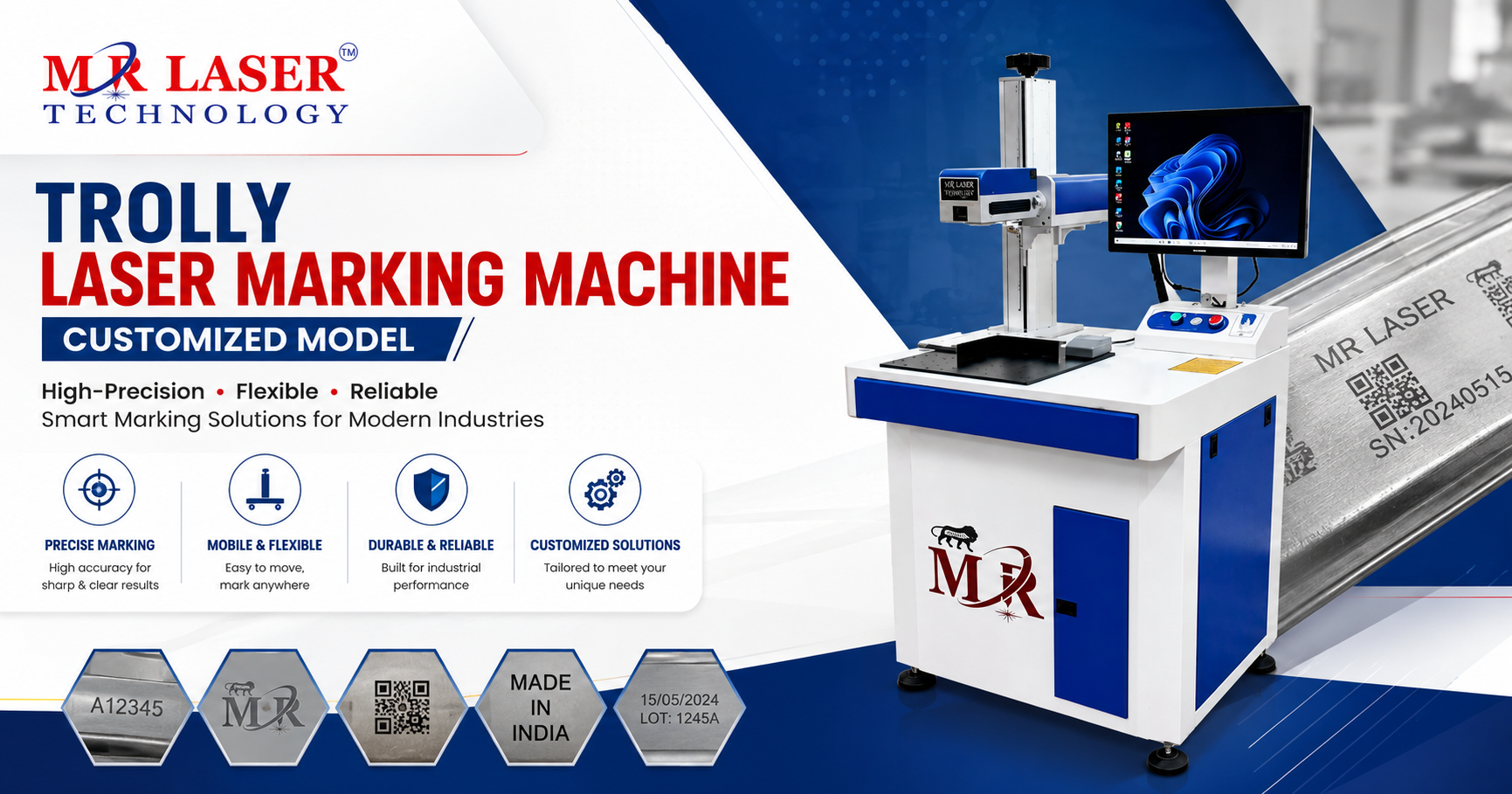
Trolly Laser Marking Machine _ Customized Model
Find customized trolly laser marking machines in Ahmedabad. MR Laser Technology offers high-precision, reliable solutions for your industrial marking needs.
What is a Trolly Laser Marking Machine? — Overview
A trolly laser marking machine is a type of industrial laser marking system mounted on a mobile platform or trolley. This design allows for greater flexibility and accessibility compared to fixed-station machines. The laser source, optics, and control system are integrated into a unit that can be easily moved to the workpiece, rather than bringing the workpiece to the machine. This is particularly useful for marking large, heavy, or already assembled items that are difficult to transport. The laser beam precisely etches or ablates material on the surface, creating permanent marks such as serial numbers, logos, dates, or barcodes.
Key Features and Technical Specifications
When considering a trolly laser marking machine, several key features and specifications are crucial for optimal performance and suitability for your application:
- Laser Source Type: Options include Fiber, CO2, or UV lasers, each suited for different materials and marking requirements. Fiber lasers are common for metals and some plastics, CO2 for non-metals, and UV for sensitive materials requiring low heat input.
- Marking Area: The size of the area the laser can cover in a single pass, typically ranging from a few square centimeters to larger areas depending on the optics.
- Laser Power: Measured in Watts (W), this determines the speed and depth of the mark, impacting its suitability for various materials and applications. Common powers range from 20W to 100W or more.
- Marking Speed: The rate at which the laser can create marks, often measured in millimeters per second (mm/s) or characters per second.
Beam Quality (M²): A measure of the laser beam's focusability, critical for achieving fine details and high-resolution marks. Lower M² values indicate better beam quality.
- Cooling System: Integrated air or water cooling systems to manage heat generated by the laser source and optics, ensuring consistent performance and longevity.
- Trolley Design: Ergonomic design, stability, maneuverability, and integrated control panel for ease of operation and movement.
- Software Interface: User-friendly software for designing marks, setting parameters, and controlling the marking process, often supporting various file formats.
Industrial Applications and Use Cases
The versatility of a trolly laser marking machine makes it suitable for a wide array of industrial applications across different sectors:
- Automotive Industry: Marking engine parts, chassis numbers, component identification, and quality control data for traceability.
- Aerospace: Engraving serial numbers, part numbers, and compliance marks on critical components where precision and durability are essential.
- Electronics Manufacturing: Marking circuit boards, components, and finished electronic devices with serial numbers, logos, and date codes.
- Medical Device Manufacturing: Marking instruments and implants with unique device identifiers (UDIs) and sterilization information, ensuring compliance and patient safety.
- Heavy Machinery: Marking large components, frames, and equipment parts directly on the assembly line or in the field.
- Tool and Die Manufacturing: Engraving identification marks, logos, and specifications onto tools, molds, and dies.
- General Manufacturing: Marking a vast range of products for branding, inventory management, and quality assurance purposes.
- Jewellery and Luxury Goods: Precisely marking intricate designs, hallmarks, and serial numbers on precious metals and items.
How to Choose the Right Trolly Laser Marking Machine
Selecting the appropriate trolly laser marking machine involves careful consideration of your specific operational needs and production environment. Here’s a checklist to guide your decision:
- Material Compatibility: Identify the primary materials you need to mark (metals, plastics, glass, etc.) to determine the most suitable laser source (Fiber, CO2, UV).
- Marking Requirements: Define the type of marks needed (text, logos, barcodes, 2D codes) and the required level of detail and contrast.
- Production Volume and Speed: Assess your daily or hourly marking output to select a machine with adequate marking speed and reliability.
- Workpiece Size and Shape: Consider the dimensions and accessibility of the items you will be marking to ensure the trolley and laser head can reach them effectively.
- Integration Needs: Determine if the machine needs to integrate with existing production lines or software systems.
- Power Source and Environment: Ensure the machine's power requirements are met and that it is suitable for your factory environment (e.g., dust, temperature).
- Customization Options: Evaluate the extent to which the machine can be customized to fit unique workflows, such as specific trolley heights, laser head articulation, or integrated fixturing.
- Supplier Support and Service: Look for a reputable supplier offering installation, training, maintenance, and readily available spare parts.
Quality Standards and Compliance
Ensuring your trolly laser marking machine adheres to relevant quality standards and compliance regulations is vital for operational integrity and product acceptance. In India, manufacturers often follow standards set by the Bureau of Indian Standards (BIS) for general industrial equipment. Internationally recognized standards like ISO 9001 for quality management systems are indicative of a manufacturer's commitment to consistent quality. For laser safety, compliance with IEC standards (e.g., IEC 60825) is crucial, ensuring the machine operates safely and protects operators. Buyers should verify that the machine's specifications meet their industry's specific compliance needs, such as UDI marking for medical devices or traceability requirements in automotive and aerospace.
Why MR Laser Technology's Experience and Capability Matters
At MR Laser Technology, our extensive experience in designing and manufacturing industrial laser machines, including specialized trolly models, sets us apart. Based in Ahmedabad, we understand the unique demands of the local and national industrial sectors. Our capability is built on a foundation of deep technical expertise, allowing us to engineer machines that offer exceptional precision and reliability. We focus on robust manufacturing processes, utilizing high-quality components to ensure durability and consistent performance.
Our technical team comprises skilled engineers who are adept at developing customized solutions. We work closely with clients to understand their specific marking challenges and then design and configure machines that precisely meet those needs. This includes tailoring the laser source, optics, software, and the trolley's mobility and ergonomics. Our commitment extends beyond manufacturing; we provide comprehensive after-sales support, including installation, training, and maintenance, ensuring your investment delivers long-term value and operational efficiency.
Installation, Maintenance, and Care Tips
Proper installation, regular maintenance, and careful operation are key to maximizing the lifespan and performance of your trolly laser marking machine.
- Installation: Ensure the machine is installed on a stable, level surface. Connect it to a reliable power source and ensure proper ventilation. Follow the manufacturer's guidelines for initial setup and calibration.
- Operator Training: Thoroughly train all operators on the machine's functions, safety protocols, and software operation. Proper handling prevents errors and accidents.
- Regular Cleaning: Keep the laser lens and mirrors clean to maintain beam quality and marking precision. Dust and debris can degrade performance. Use appropriate cleaning solutions and materials recommended by the manufacturer.
- System Checks: Periodically check all connections, cables, and mechanical components for wear or damage. Ensure cooling systems are functioning correctly.
- Software Updates: Keep the machine's control software updated to benefit from performance enhancements and bug fixes.
- Preventive Maintenance: Adhere to the recommended preventive maintenance schedule, which may include checking laser source performance, calibrating axes, and inspecting safety interlocks.
- Environmental Control: Operate the machine within the recommended temperature and humidity ranges to prevent component stress and failure.
Frequently Asked Questions
Trolly laser marking machines can mark a wide range of materials, including metals (steel, aluminum, brass, gold, silver), plastics, ceramics, glass, leather, wood, and certain composites. The specific laser source (Fiber, CO2, UV) will determine the optimal material compatibility.
The trolley design allows the machine to be easily moved to the workpiece, which is ideal for marking large, heavy, or already assembled items that cannot be brought to a fixed machine. This mobility streamlines operations on the production floor and in diverse work environments.
The lifespan of a laser source varies significantly based on its type and usage. Fiber laser sources, commonly used for metal marking, can typically last between 50,000 to 100,000 operating hours. CO2 and UV lasers may have different lifespans depending on their technology and operating conditions.
Yes, modern trolly laser marking machines, equipped with sophisticated control software, are capable of marking intricate designs, logos, high-resolution images, serial numbers, date codes, and various types of barcodes and 2D data matrix codes with high precision.
Reputable manufacturers typically offer comprehensive after-sales support, including installation assistance, operator training, technical troubleshooting, routine maintenance services, and the availability of spare parts. This ensures the machine operates efficiently and reliably long-term.
A customized trolly laser marking machine is specifically engineered to meet unique client requirements. This can involve modifications to the trolley's dimensions, lifting capacity, laser head articulation, marking area, software features, or integration with specific production line equipment, offering a tailored solution beyond standard configurations.
Conclusion
For industries in Ahmedabad seeking to enhance their marking capabilities with precision, flexibility, and efficiency, a trolly laser marking machine presents a compelling solution. The ability to customize these machines to specific material types, workpiece dimensions, and workflow requirements is crucial for achieving optimal results. By understanding the key features, applications, and selection criteria, businesses can invest in equipment that not only meets their current needs but also supports future growth and operational excellence. Partnering with an experienced manufacturer like MR Laser Technology ensures you receive a reliable, high-performance solution backed by expert support.
Get In Touch
Mr Laser Technology