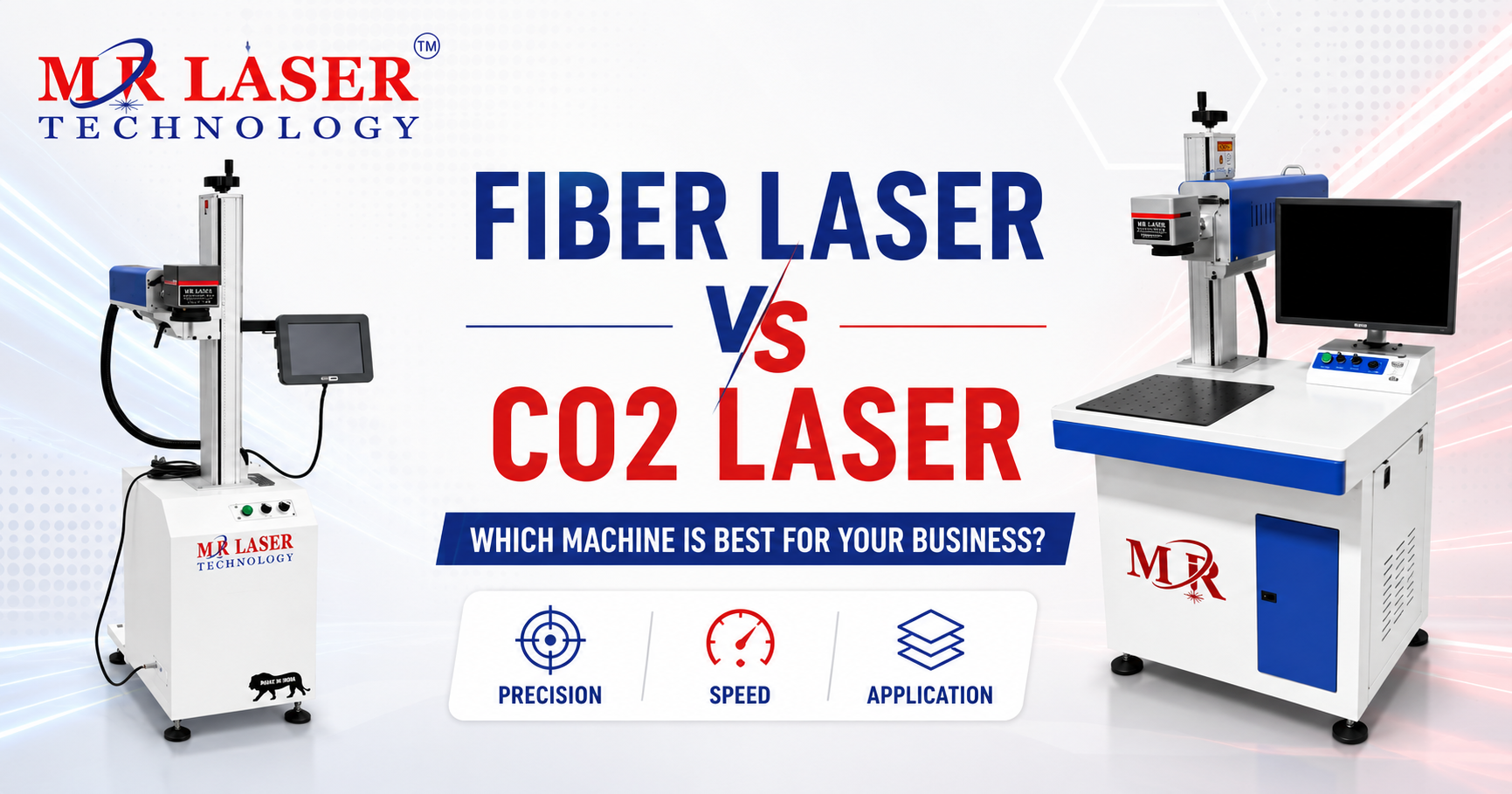
Fiber Laser vs CO2 Laser: Which Machine Is Best for Your Business?
Ahmedabad businesses: Learn the key differences between Fiber and CO2 laser machines to select the right one for your industrial marking and cutting needs.
Why This Matters in Ahmedabad
Ahmedabad's vibrant industrial landscape, known for its strong presence in textiles, pharmaceuticals, chemicals, and manufacturing, demands precision and efficiency. Businesses here are constantly seeking ways to enhance production, improve product quality, and maintain a competitive edge. Whether you're marking intricate designs on metal components for automotive suppliers or cutting precise patterns for garment manufacturers, the right laser technology can be a game-changer. Making the wrong choice can lead to limitations in material processing, increased operational expenses, and missed opportunities for innovation.
What is Fiber Laser vs. CO2 Laser — Overview
At their core, both Fiber and CO2 lasers use stimulated emission to produce a concentrated beam of light for cutting, marking, or engraving. The primary distinction lies in how this beam is generated and the wavelength of the light produced. Fiber lasers utilize a semiconductor diode to pump light into an optical fiber doped with rare-earth elements, creating a highly concentrated beam with a shorter wavelength. CO2 lasers, on the other hand, use an electrical discharge to excite a gas mixture (carbon dioxide, nitrogen, helium) within a sealed tube, producing a longer wavelength beam. This fundamental difference in wavelength dictates their interaction with various materials.
Key Features and Technical Specifications
The technical characteristics of Fiber and CO2 laser machines define their performance and suitability for different tasks.
Fiber Laser:
- Wavelength: Typically 1064 nm (near-infrared).
- Beam Quality: Excellent, allowing for very fine detail and high power density.
- Efficiency: High electrical-to-optical conversion efficiency, leading to lower running costs.
- Maintenance: Solid-state technology with no consumables like gas or mirrors to replace regularly, resulting in lower maintenance.
- Lifespan: Diode lifespan can exceed 100,000 hours.
- Spot Size: Can achieve very small spot sizes, ideal for intricate marking.
CO2 Laser:
- Wavelength: Typically 10.6 µm (far-infrared).
- Beam Quality: Good, but generally less focused than fiber lasers for the same power.
- Efficiency: Lower electrical-to-optical conversion efficiency compared to fiber lasers.
- Maintenance: Requires periodic replacement of gas, mirrors, and potentially laser tubes, increasing operational complexity and cost.
- Lifespan: Laser tube lifespan varies, often requiring replacement after several thousand hours of operation.
- Material Interaction: Excellent absorption by non-metallic materials.
Industrial Applications and Use Cases
The distinct properties of Fiber and CO2 lasers lend themselves to a wide array of industrial applications across Ahmedabad's diverse manufacturing sectors.
Fiber Laser Applications:
Metal marking and engraving (stainless steel, aluminum, brass, titanium).
Precision cutting of thin to medium-thickness metals.
Annealing and hardening of metals.
Marking on plastics and some coated materials.
Jewellery manufacturing for intricate marking and cutting.
Automotive parts marking for traceability.
Electronics component marking.
CO2 Laser Applications:
Cutting and engraving of non-metals like wood, acrylic, leather, fabric, paper, and rubber.
Marking on plastics, glass, and coated metals.
Engraving on stone and ceramics.
Signage and awards manufacturing.
Textile industry for cutting and marking patterns.
Packaging industry for cutting and marking.
Promotional product customization.
How to Choose the Right Laser Machine
Selecting the appropriate laser machine requires a careful assessment of your specific business needs and operational requirements. Consider these factors when making your decision:
- Primary Material Type: Are you primarily working with metals, non-metals, or a mix? Fiber lasers excel with metals, while CO2 lasers are superior for most non-metals.
- Application Focus: Is your main goal marking, cutting, welding, or engraving? Different lasers are optimized for different processes.
- Required Precision and Detail: For very fine details and intricate designs, especially on metals, a fiber laser often provides superior results.
- Throughput and Speed: Consider the speed at which you need to complete tasks. Both technologies offer high-speed options, but their effectiveness varies by material.
- Power Requirements: The thickness and type of material will dictate the necessary laser power.
- Budget and Operational Costs: Factor in the initial investment, as well as ongoing costs for consumables, maintenance, and energy consumption.
- Supplier Support and Service: Evaluate the availability of technical support, training, and after-sales service in Ahmedabad.
Quality Standards and Compliance
For any industrial machinery, especially precision equipment like laser systems, adhering to quality standards and compliance is paramount. In India, manufacturers and buyers alike should look for machines that meet national and international benchmarks. This includes certifications like ISO 9001 for quality management systems, ensuring consistent production processes. For laser machines themselves, compliance with relevant BIS (Bureau of Indian Standards) or IEC (International Electrotechnical Commission) standards for electrical safety and performance is crucial. Reputable suppliers will readily provide documentation regarding their adherence to these standards, assuring you of the machine's safety, reliability, and performance capabilities. Verifying these credentials before purchase provides peace of mind and reduces the risk of acquiring substandard equipment.
Why MR Laser Technology's Experience and Capability Matters
At MR Laser Technology, our extensive experience in the field of laser machine manufacturing, particularly serving industries in Ahmedabad and across India, forms the bedrock of our commitment to quality and innovation. We understand the nuances of different materials and applications, allowing us to design and build machines that deliver exceptional results. Our manufacturing processes are honed over years, incorporating advanced technologies to ensure precision and durability. Our technical team comprises seasoned engineers with deep expertise in laser systems, capable of not only building robust machines but also providing insightful guidance and tailored solutions.
We pride ourselves on our stringent quality control measures, ensuring every machine leaving our facility meets rigorous performance benchmarks. This dedication extends to our ability to customize solutions, adapting our standard designs to meet unique client specifications. Coupled with our reliable delivery network and comprehensive after-sales support, MR Laser Technology stands as a trustworthy partner for businesses seeking advanced laser solutions.
Installation, Maintenance, and Care Tips
Proper installation, regular maintenance, and careful operation are key to maximizing the lifespan and performance of your laser machine, whether it's a Fiber or CO2 system.
- Installation: Ensure the machine is installed on a stable, level surface in a well-ventilated area, away from excessive dust or moisture. Proper electrical grounding is essential for safety and optimal performance. For CO2 lasers, ensure adequate ventilation for the gas mixture.
- Daily Checks: Before operation, inspect the laser path for any obstructions. For CO2 lasers, check gas levels and pressure. Ensure cooling systems are functioning correctly.
- Regular Cleaning: Keep optical components (lenses, mirrors) clean using appropriate cleaning solutions and lint-free cloths. Dust and debris can significantly degrade beam quality and performance. Regularly clean the machine's exterior and work area.
- Cooling System Maintenance: The chiller unit is vital for preventing overheating. Regularly check coolant levels and quality. Clean chiller filters to ensure efficient heat dissipation.
- Exhaust and Filtration: Ensure your fume extraction system is functioning correctly to remove smoke and particulate matter generated during processing. This protects both the machine's internal components and the operator's health.
- Software Updates: Keep your machine's control software updated to benefit from performance enhancements and bug fixes.
- Professional Servicing: Schedule periodic professional servicing as recommended by the manufacturer. This ensures all components are checked, calibrated, and any potential issues are addressed proactively.
Frequently Asked Questions
For cutting thin to medium-thickness metals, Fiber lasers are generally preferred due to their excellent beam quality and ability to achieve high power densities, resulting in cleaner cuts and faster speeds compared to CO2 lasers.
Yes, Fiber lasers can mark many types of plastics, especially those with specific additives or fillers. However, the results can vary significantly depending on the plastic composition. CO2 lasers are often more versatile for marking a broader range of plastics.
The lifespan of a CO2 laser tube varies greatly depending on the manufacturer, power, and usage. Generally, they can last anywhere from 1,000 to 10,000 operating hours, after which they need to be replaced, which is a significant ongoing cost.
The shorter wavelength of Fiber lasers (1064 nm) is well-absorbed by metals, allowing for efficient cutting and marking. The longer wavelength of CO2 lasers (10.6 µm) is highly absorbed by organic materials like wood, acrylic, and leather, making them ideal for these applications.
Yes, Fiber lasers are significantly more energy-efficient. Their solid-state design allows for higher electrical-to-optical conversion rates, meaning they consume less power to produce the same laser output compared to CO2 lasers.
Fiber lasers are known for their low maintenance requirements. They are solid-state devices with no consumables like gas or mirrors to replace regularly. The primary maintenance involves keeping the optics clean and ensuring the cooling system functions correctly.
Conclusion
The decision between a Fiber laser and a CO2 laser machine hinges on your specific operational needs, particularly the types of materials you process and the applications you undertake. For businesses in Ahmedabad focused on metal marking, cutting, and intricate detailing, a Fiber laser often represents the more efficient and precise choice. Conversely, if your work primarily involves non-metallic materials like wood, acrylic, leather, or fabric, a CO2 laser will likely provide superior results and versatility.
By carefully evaluating your material requirements, desired precision, throughput, and budget, you can confidently select the technology that best aligns with your business objectives. Partnering with an experienced manufacturer like MR Laser Technology ensures you receive not only a high-quality machine but also the expert guidance needed to make the optimal investment for your manufacturing future.
Get In Touch
Mr Laser Technology