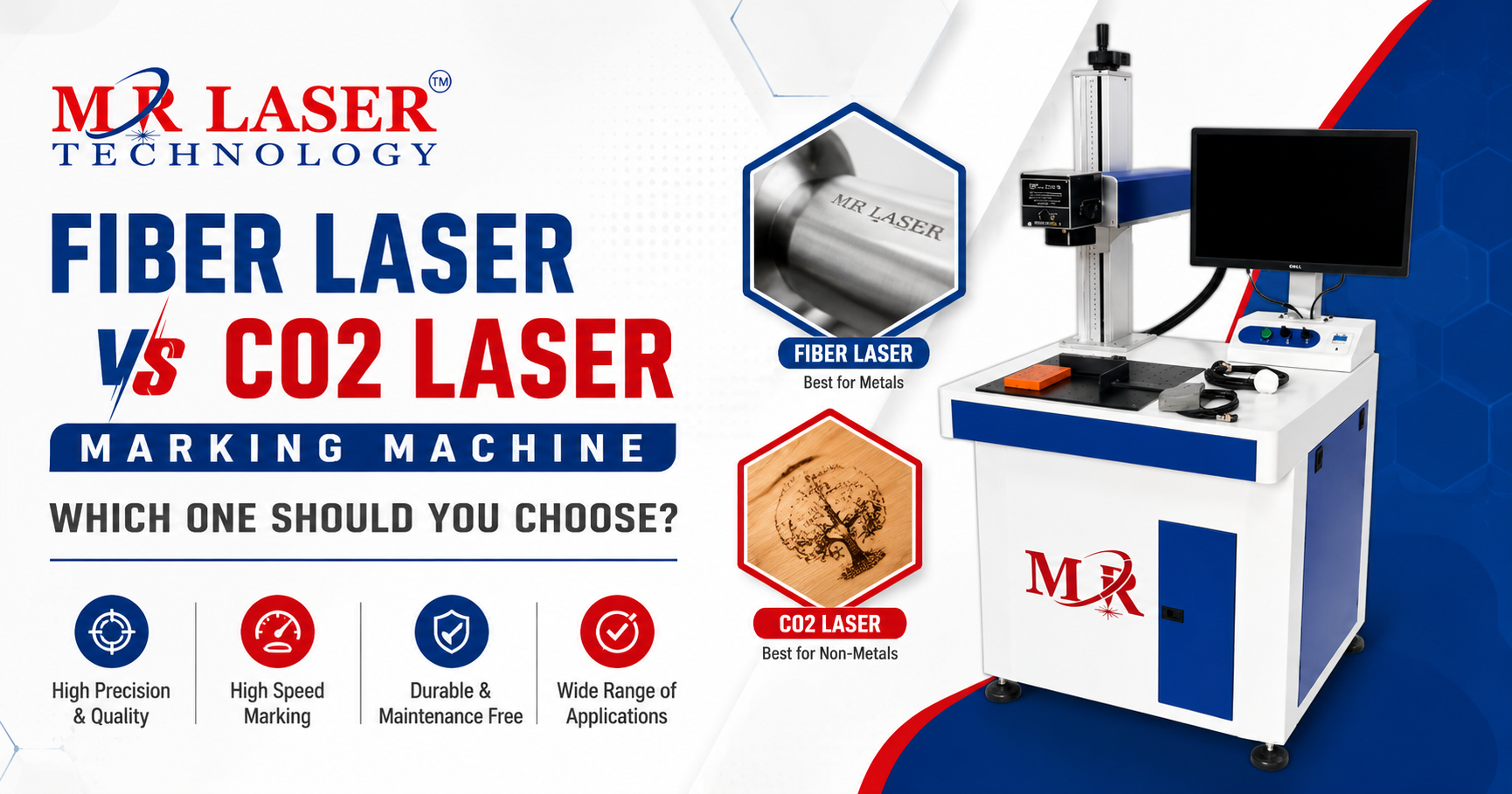
Fiber Laser vs CO2 Laser Marking Machine: Which One Should You Choose?
Choosing between Fiber and CO2 laser marking machines in Ahmedabad? Understand the differences, applications, and benefits to select the right machine for your
Why This Matters in Ahmedabad
Ahmedabad, a vibrant industrial hub in Gujarat, hosts a diverse range of manufacturing sectors, from textiles and pharmaceuticals to automotive components and metal fabrication. Each of these industries relies on precise and durable marking for product identification, traceability, and branding. The demand for efficient, high-quality marking solutions is constant, making the selection of appropriate laser technology crucial for maintaining competitiveness and meeting stringent industry standards within the region.
What is a Fiber Laser Marking Machine?
A Fiber laser marking machine utilizes a laser beam generated by a fiber optic cable. This method produces a highly concentrated beam with excellent beam quality, allowing for very fine details and high-speed marking. The laser light is delivered through a flexible fiber optic cable, offering greater maneuverability and durability compared to traditional beam delivery systems. These machines are particularly adept at marking metals and certain plastics.
What is a CO2 Laser Marking Machine?
A CO2 laser marking machine uses a gas mixture (carbon dioxide, nitrogen, helium) excited by an electrical discharge to produce a laser beam. This type of laser operates at a longer wavelength than fiber lasers, making it highly effective for marking and engraving a wide array of non-metal materials. CO2 lasers are versatile and can also mark certain metals with specific coatings or treatments.
Key Features and Technical Specifications
Fiber Laser Marking Machines:
- Wavelength: Typically 1064 nm, ideal for metals.
- Beam Quality: Excellent, enabling fine detail and high resolution.
- Marking Speed: Very high, suitable for mass production.
- Material Compatibility: Primarily metals (stainless steel, aluminum, brass, etc.) and some plastics.
- Power Options: Available in various wattages (e.g., 20W, 30W, 50W) for different applications.
- Lifespan: Long operational life with minimal maintenance.
- Cooling: Air-cooled for most models, simplifying setup.
- Marking Depth: Capable of achieving deep engraving on suitable materials.
CO2 Laser Marking Machines:
- Wavelength: Typically 10.6 µm, ideal for non-metals.
- Beam Quality: Good, suitable for a wide range of marking tasks.
- Marking Speed: Moderate to high, depending on material and power.
- Material Compatibility: Excellent for non-metals (wood, acrylic, leather, glass, rubber, paper) and some coated metals.
- Power Options: Available in various wattages (e.g., 30W, 60W, 100W) for diverse applications.
- Lifespan: Dependent on gas mixture and maintenance.
- Cooling: Often water-cooled, requiring a chiller system.
- Marking Depth: Can achieve significant depth on softer non-metal materials.
Industrial Applications and Use Cases
Fiber Laser Marking Machines:
- Automotive Industry: Marking VIN numbers, part numbers, and logos on metal components.
- Electronics Manufacturing: Marking serial numbers, logos, and specifications on electronic parts and casings.
- Jewelry Industry: Engraving intricate designs and personalization on metal jewelry.
- Medical Devices: Marking sterilization codes and identification on surgical instruments and implants.
- Aerospace: Marking critical components with serial numbers and traceability codes.
- Hardware and Tools: Marking brand names, specifications, and logos on tools and hardware.
CO2 Laser Marking Machines:
- Packaging Industry: Marking dates, batch codes, and logos on cardboard, plastic films, and paper.
- Textile Industry: Marking designs, logos, and labels on fabrics and leather goods.
- Promotional Products: Personalizing pens, keychains, and other promotional items made from plastic or wood.
- Glassware and Ceramics: Engraving designs and logos on bottles, glasses, and decorative items.
- Rubber and Plastics: Marking components, seals, and identification on various rubber and plastic parts.
- Woodworking: Engraving intricate designs and text on wooden products and furniture.
How to Choose the Right Laser Marking Machine
Selecting the appropriate laser marking machine requires careful consideration of your specific operational needs. Here’s a checklist to guide your decision:
- Material Type: Are you primarily marking metals or non-metals? Fiber lasers excel with metals, while CO2 lasers are best for non-metals.
- Application Requirements: Do you need deep engraving, high-speed marking, or intricate detail?
- Marking Area Size: Consider the maximum size of the area you need to mark.
- Throughput Needs: How many parts do you need to mark per hour or per shift?
- Budget Considerations: While initial cost is a factor, consider the long-term operational costs, including maintenance and consumables.
- Power Requirements: Match the laser power to the material hardness and desired marking depth/speed.
- Supplier Support: Look for a reputable supplier with strong after-sales service, installation, and training capabilities.
- Certifications and Compliance: Ensure the machine meets relevant industry standards for safety and performance.
Quality Standards and Compliance
When investing in a laser marking machine, verifying adherence to quality standards is paramount. Reputable manufacturers, like Mr Laser Technology, often ensure their machines comply with international standards such as ISO and CE certifications. These certifications indicate that the machines have undergone rigorous testing for safety, performance, and quality management systems. Buyers should inquire about these certifications and any specific industry compliance requirements relevant to their sector. Ensuring the machine's construction, electrical safety, and operational reliability meet these benchmarks provides confidence in its long-term performance and safety.
Why Mr Laser Technology's Experience and Capability Matters
With over 8 years of dedicated experience in laser technology, Mr Laser Technology has established a strong foundation in manufacturing high-precision laser marking machines. Our expertise lies in understanding the nuanced requirements of various industrial applications, from intricate jewelry marking to robust industrial component identification. We focus on delivering machines built with advanced laser sources and optics, ensuring consistent quality and reliability.
Our manufacturing process emphasizes stringent quality control at every stage, from component selection to final assembly and testing. This meticulous approach guarantees that each machine leaving our facility meets high performance standards. The technical capability of our engineering team allows us to offer customized solutions tailored to specific client needs, ensuring optimal integration into existing production lines. Furthermore, our commitment extends to providing comprehensive after-sales support, including installation, training, and maintenance, ensuring our clients achieve maximum value and operational efficiency from their investment.
Installation, Maintenance, and Care Tips
Proper installation and regular maintenance are key to maximizing the lifespan and performance of your laser marking machine.
- Installation: Ensure the machine is installed on a stable, level surface in a well-ventilated area. Connect all necessary power and cooling systems according to the manufacturer's guidelines. Professional installation by a qualified technician is highly recommended.
- Daily Checks: Before operation, visually inspect the machine for any loose connections or debris. Ensure the laser safety enclosure is functioning correctly.
- Lens and Mirror Cleaning: The optical components, especially the focusing lens and mirrors, are critical for beam quality. Clean them regularly using appropriate optical cleaning solutions and lint-free cloths. Avoid touching the lens surface with bare hands.
- Ventilation System: Laser marking can produce fumes and particulate matter. Ensure the exhaust and ventilation system is clean, functional, and properly venting away from the workspace.
- Cooling System (for CO2 lasers): Maintain the correct coolant level and temperature in the chiller unit. Regularly check for leaks or blockages in the cooling lines.
- Software Updates: Keep the machine's control software updated to benefit from performance enhancements and bug fixes.
- Scheduled Maintenance: Follow the manufacturer's recommended maintenance schedule for component checks, lubrication, and potential part replacements.
Frequently Asked Questions
The main distinction lies in the type of material they are best suited for. Fiber lasers, with their shorter wavelength, are highly effective for marking metals and some plastics due to their ability to be absorbed by these materials. CO2 lasers, with their longer wavelength, are ideal for marking a wide range of non-metal materials like wood, acrylic, leather, and glass.
While primarily designed for metals, Fiber lasers can mark certain non-metal materials, especially plastics. However, the results may not be as crisp or deep as those achieved with a CO2 laser on the same material. For plastics, the specific type and additives can influence the marking outcome.
A CO2 laser can mark metal, but typically only if the metal is coated or treated. The laser beam is absorbed by the coating, which is then vaporized or altered to reveal the underlying metal or create a mark. For bare metals, a Fiber laser is generally the more efficient and effective choice.
Fiber lasers generally offer higher marking speeds, especially on metals, due to their excellent beam quality and efficiency. This makes them ideal for high-volume production environments where rapid marking is essential for maintaining throughput.
Fiber lasers typically require less maintenance due to their solid-state nature and air-cooling systems, often needing only occasional cleaning of optics. CO2 lasers may require more maintenance, including periodic gas refills, chiller system upkeep, and more frequent optical cleaning.
The required power depends on the material being marked, the desired marking depth, and the speed of operation. For metals, higher power Fiber lasers are often needed for deeper engraving. For non-metals, CO2 laser power is selected based on material thickness and the complexity of the design. Consulting with a supplier like Mr Laser Technology can help determine the optimal power for your specific application.
Conclusion
The decision between a Fiber laser and a CO2 laser marking machine in Ahmedabad hinges on your primary materials and application requirements. Fiber lasers offer superior performance for metal marking, providing high precision and speed. CO2 lasers are the go-to solution for a broad spectrum of non-metal materials, offering versatility and excellent marking quality. By understanding these differences and considering factors like material compatibility, speed, and specific application needs, you can confidently select the laser marking technology that will best serve your industrial operations and contribute to your manufacturing success.
---
Get In Touch
Mr Laser Technology