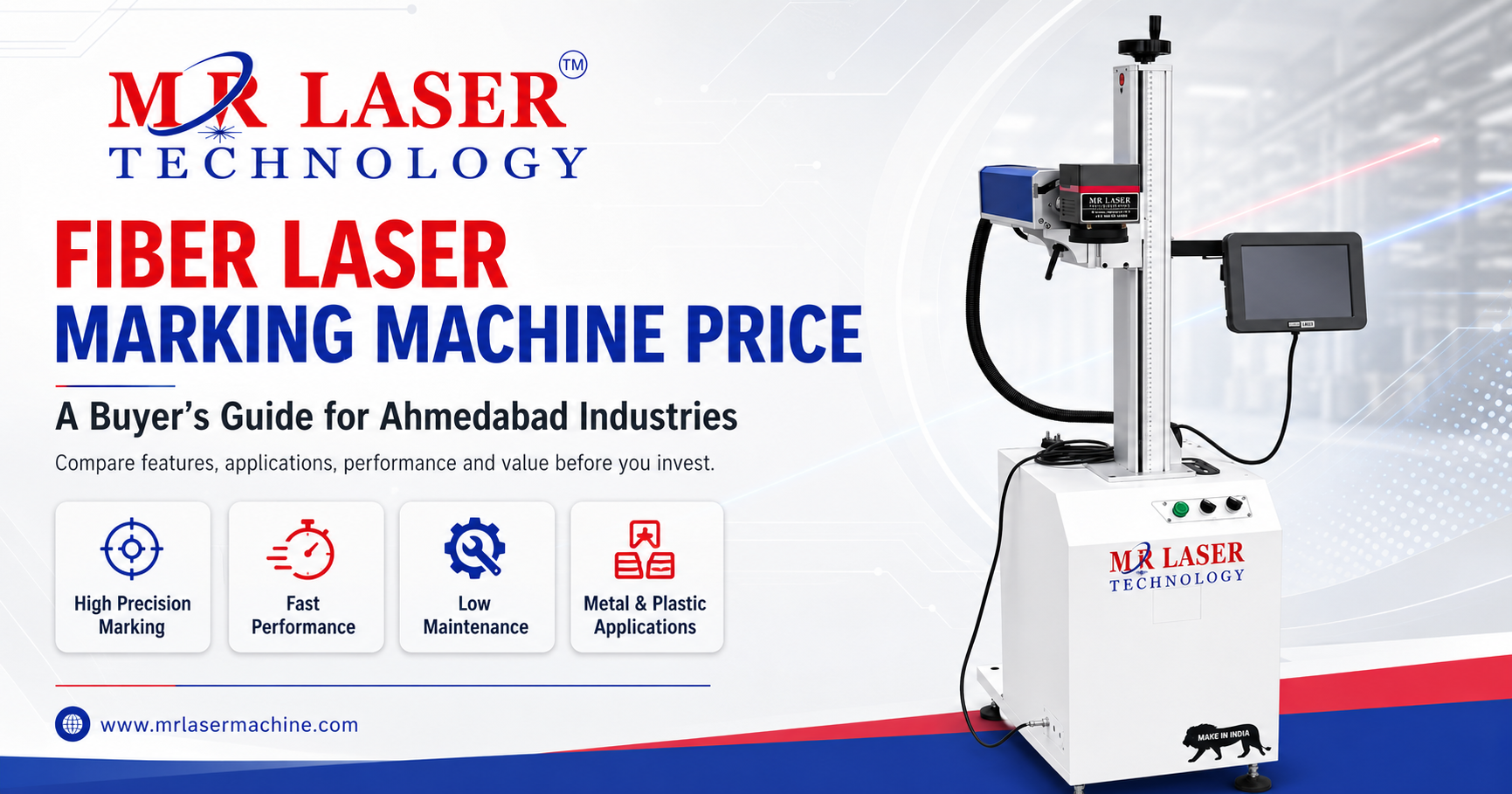
Fiber Laser Marking Machine Price
Find competitive fiber laser marking machine prices in Ahmedabad. Mr Laser Technology offers high-precision, ISO-certified machines with expert support.
Key Features and Technical Specifications
When evaluating fiber laser marking machines, several technical specifications directly impact performance and, consequently, price. Understanding these will help you match a machine to your specific application requirements.
- Laser Source Power: Typically ranging from 20W to 100W or more, higher power generally means faster marking speeds and the ability to mark harder materials or deeper engravings.
- Wavelength: The standard wavelength for fiber lasers is 1064nm, which is highly effective for most metals and many plastics.
Beam Quality (M²): A lower M² value indicates a more focused and precise beam, leading to finer detail and sharper marks.
- Marking Area: This is the maximum size of the workpiece that can be marked in a single operation, often specified as 100x100mm, 150x150mm, or larger.
- Marking Speed: Measured in millimeters per second (mm/s), this indicates how quickly the laser head can traverse the marking area, directly impacting throughput.
- Repetition Rate: The frequency at which laser pulses are emitted, affecting marking depth and speed.
- Cooling System: Most fiber lasers use air cooling for lower power units, while higher power or continuous operation may require water cooling.
- Software Interface: User-friendly software is essential for designing marks, setting parameters, and integrating with production lines.
Industrial Applications and Use Cases
The versatility of fiber laser marking machines makes them indispensable across numerous industrial sectors, particularly those thriving in and around Ahmedabad.
- Automotive Component Marking: Permanently marking part numbers, serial numbers, logos, and manufacturing dates on engine parts, chassis components, and electronic modules for traceability.
- Electronics Manufacturing: Marking serial numbers, model numbers, and QR codes on circuit boards, casings, and individual electronic components.
- Aerospace Industry: High-precision marking of critical part identification for safety and regulatory compliance on metal and composite materials.
- Medical Device Marking: Engraving unique device identifiers (UDIs), serial numbers, and sterilization indicators on surgical instruments and implants, ensuring compliance with strict regulations.
- Jewellery and Watchmaking: Intricate marking of hallmarks, logos, serial numbers, and decorative patterns on precious metals and watch components.
- Tool and Die Marking: Engraving identification marks, logos, and specifications onto industrial tools, molds, and dies.
- Promotional Items and Gifts: Personalizing metal pens, keychains, and other corporate gifts with logos and names.
- General Manufacturing: Marking any metal or plastic part for inventory management, branding, or quality assurance.
How to Choose the Right Fiber Laser Marking Machine
Selecting the appropriate fiber laser marking machine involves assessing your specific operational needs and ensuring the chosen system aligns with your production goals.
- Material Compatibility: Confirm the machine can effectively mark your primary materials (e.g., stainless steel, aluminum, brass, titanium, ABS, PEEK).
- Throughput Requirements: Evaluate the required marking speed and the number of parts you need to mark per shift or day.
- Marking Detail and Depth: Determine the complexity and depth of the marks needed for your application.
- Integration Needs: Consider if the machine needs to be integrated into an existing production line or automated system.
- Workpiece Size and Handling: Ensure the marking area is sufficient and that the machine can accommodate the size and shape of your parts.
- Supplier Support and Service: Investigate the availability of technical support, training, and spare parts in your region.
- Budget and Total Cost of Ownership: While initial price is a factor, consider long-term costs including maintenance, consumables, and potential downtime.
Quality Standards and Compliance
For industrial machinery, adherence to quality standards and compliance with relevant regulations is paramount. When investing in a fiber laser marking machine, look for manufacturers who demonstrate a commitment to quality. This often includes certifications such as ISO 9001 for quality management systems. While specific laser marking machine standards might vary, ensuring the components used are of high quality and that the machine is built to last is essential. Buyers should verify that the machine's electrical components meet safety standards and that the laser safety features are robust and compliant with international guidelines.
Why MR Laser Technology's Experience and Capability Matter
At MR Laser Technology, our extensive experience in laser machine manufacturing, particularly in Ahmedabad, allows us to understand the nuanced demands of modern industries. We focus on delivering high-precision fiber laser marking machines built with advanced technology and robust engineering. Our manufacturing process emphasizes quality control at every stage, from component selection to final assembly and testing.
Our technical team comprises skilled engineers with deep expertise in laser applications, enabling us to offer customized solutions tailored to your unique marking requirements. We pride ourselves on our ability to provide reliable after-sales support, including installation, training, and ongoing maintenance, ensuring your investment continues to perform optimally. This commitment to quality, customization, and customer satisfaction is what sets MR Laser Technology apart.
Installation, Maintenance, and Care Tips
Proper installation and regular maintenance are key to maximizing the lifespan and performance of your fiber laser marking machine.
- Installation Environment: Ensure the machine is installed in a clean, dry, and well-ventilated area, away from excessive dust or vibrations.
- Power Supply: Connect the machine to a stable and properly grounded power source, using surge protectors if necessary.
- Regular Cleaning: Keep the laser lens and mirrors clean using appropriate cleaning solutions and lint-free cloths. Dust or debris on optical components can degrade beam quality and performance.
- Ventilation System: Ensure the fume extraction system is functioning correctly to remove any fumes generated during the marking process, protecting both the machine and the operator.
- Software Updates: Keep the machine's control software updated to benefit from performance enhancements and bug fixes.
- Scheduled Maintenance: Follow the manufacturer's recommended maintenance schedule, which may include checking connections, lubricating moving parts, and inspecting optical components.
- Operator Training: Ensure all operators are thoroughly trained on the machine's operation, safety features, and basic troubleshooting.
Frequently Asked Questions
The price of a fiber laser marking machine can vary significantly based on its power, features, brand, and the supplier's service package. Generally, entry-level machines suitable for basic marking tasks start at a lower price point, while high-power, high-speed, or fully automated systems command a higher investment.
Yes, fiber laser marking machines can mark a variety of plastics, especially those with additives that react to the laser's wavelength. Different plastics may require specific laser parameters, such as pulse duration and power, to achieve optimal results without damaging the material.
Fiber laser sources are known for their longevity and low maintenance. A typical fiber laser source can operate for tens of thousands of hours, often exceeding 100,000 hours, before any significant degradation in performance occurs.
A larger marking area typically increases the cost of the machine. This is because larger galvanometer scanners and more robust motion systems are required to cover a wider area with precision and speed.
Reputable suppliers offer comprehensive after-sales support, which may include installation, on-site training for operators and technicians, warranty services, and readily available technical assistance for troubleshooting and maintenance.
Absolutely. Many fiber laser marking machines are designed for integration into automated production lines. They can be equipped with features like automatic loading/unloading mechanisms, rotary attachments for cylindrical parts, and communication interfaces for seamless connection with PLCs and other factory automation systems.
Conclusion
Investing in a fiber laser marking machine is a strategic decision that can significantly enhance your manufacturing capabilities in Ahmedabad. While the price is an important consideration, it should be viewed in the context of the machine's performance, reliability, and the long-term value it brings through increased efficiency, precision, and product quality. By carefully evaluating your specific needs, understanding the technical specifications, and partnering with an experienced and trustworthy supplier like MR Laser Technology, you can secure a solution that meets your current demands and supports your future growth.
Get In Touch
Mr Laser Technology