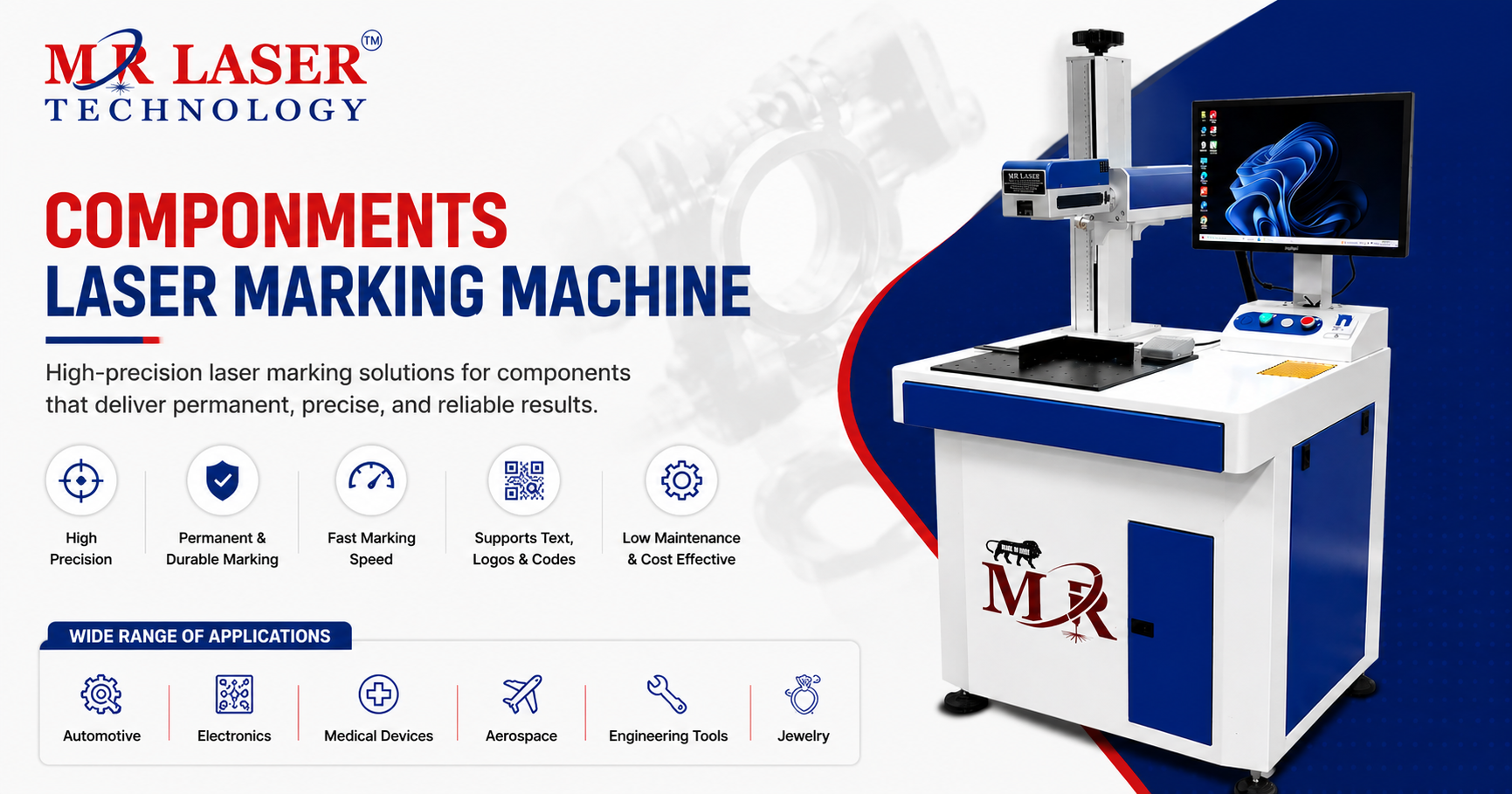
Componments Laser Marking Machine
Find high-precision Componments Laser Marking Machines in Ahmedabad. MR Laser Technology offers reliable, efficient solutions for industrial marking needs.
What is a Componments Laser Marking Machine? — Overview
A componments laser marking machine utilizes a focused laser beam to create a permanent mark on the surface of a component. This process works by altering the surface of the material through melting, vaporizing, or chemical change, depending on the material and the laser type. Unlike traditional methods like stamping or ink-jet printing, laser marking offers superior precision, durability, and versatility. These machines can engrave text, logos, serial numbers, barcodes, and even 2D data matrix codes onto a wide array of materials, including metals, plastics, ceramics, and treated wood.
Key Features and Technical Specifications
When evaluating a componments laser marking machine, several technical aspects are crucial for ensuring optimal performance and suitability for your specific applications.
- Laser Source Power: Typically ranging from 20W to 100W or more, the power determines the depth and speed of the marking.
- Wavelength: Common wavelengths include 1064nm (Fiber Laser) for metals and some plastics, and 355nm (UV Laser) for more sensitive materials.
- Marking Area: The size of the working field, commonly ranging from 100x100mm to 300x300mm, dictates the maximum size of the mark or the number of components that can be marked simultaneously.
- Marking Speed: Measured in characters per second or millimeters per second, this indicates the machine's efficiency in production environments.
Beam Quality (M²): A lower M² value indicates a more focused beam, leading to finer details and higher precision.
- Repetition Rate: For pulsed lasers, this is the number of pulses per second, affecting marking speed and depth.
- Cooling System: Air-cooled or water-cooled systems ensure stable operation and longevity of the laser source.
- Control Software: User-friendly software allows for easy design input, parameter adjustment, and integration with production lines.
Industrial Applications and Use Cases
The versatility of componments laser marking machines makes them suitable for a broad spectrum of industrial applications across various sectors.
- Automotive: Marking engine parts, chassis numbers, VIN codes, and electronic components for traceability and anti-counterfeiting.
- Electronics: Engraving serial numbers, logos, and QR codes on PCBs, semiconductors, and consumer electronics for identification and tracking.
- Medical Devices: Marking surgical instruments, implants, and diagnostic equipment with unique identifiers for regulatory compliance and patient safety.
- Aerospace: Marking critical components with high precision for traceability and quality assurance in a highly regulated industry.
- Jewelry: Engraving intricate designs, hallmarks, and personalization on precious metals with exceptional detail.
- Tools and Hardware: Marking brand names, model numbers, and specifications on tools for identification and inventory.
- Plastics and Polymers: Marking durable identification on plastic parts, often used in consumer goods and industrial equipment.
- Promotional Items: Personalizing pens, keychains, and other promotional products with logos and text.
How to Choose the Right Componments Laser Marking Machine
Selecting the appropriate componments laser marking machine is critical for achieving desired results and ensuring a good return on investment. Consider these factors:
- Material Compatibility: Identify all materials you need to mark. Fiber lasers are excellent for metals, while UV or CO2 lasers might be better for plastics or organic materials.
- Application Requirements: Determine the type of mark needed – engraving, annealing, ablation, or color change. This influences the laser source and power.
- Production Volume and Speed: For high-volume production, a faster marking speed and a larger marking area are essential.
- Precision and Detail: If intricate details or very small text are required, a laser with excellent beam quality and resolution is necessary.
- Integration Needs: Consider if the machine needs to be integrated into an existing production line, requiring specific automation features or software compatibility.
- Durability and Reliability: Look for robust construction and reliable components, especially if the machine will operate in a demanding industrial environment.
- Supplier Support: Evaluate the manufacturer's reputation, warranty, after-sales service, and availability of spare parts.
- Budget and Total Cost of Ownership: Beyond the initial purchase price, consider consumables, maintenance, and energy consumption.
Quality Standards and Compliance
Ensuring that your componments laser marking machine adheres to relevant quality standards and compliance regulations is paramount for product integrity and market acceptance. Manufacturers often strive to meet international standards such as ISO 9001 for quality management systems, demonstrating a commitment to consistent product quality and customer satisfaction. CE marking indicates that the product meets European Union health, safety, and environmental protection requirements.
For specific applications, such as in the medical or aerospace industries, compliance with industry-specific standards might be necessary. It is advisable to verify that the laser marking machine's components, particularly the laser source and safety features, meet recognized industry benchmarks. A reputable supplier will readily provide documentation regarding their adherence to these standards, assuring you of the machine's safety, reliability, and performance.
Why MR Laser Technology's Experience and Capability Matters
At MR Laser Technology, our extensive experience in manufacturing advanced laser machines, including componments laser marking machines, sets us apart. With over eight years of dedicated service and a portfolio of over 1200 successfully completed projects across India, we possess a deep understanding of industrial marking challenges. Our manufacturing process is built on precision engineering and the integration of high-quality laser sources and components, ensuring robust and reliable performance.
Our technical team comprises skilled engineers and technicians who are adept at designing, customizing, and supporting our laser systems. This expertise allows us to offer tailored solutions that precisely match your material, application, and production needs. We are committed to stringent quality control throughout the manufacturing cycle, from component selection to final testing, guaranteeing that each machine delivers consistent, high-quality results. Our focus on customer satisfaction extends to reliable after-sales support, ensuring your operations run smoothly long after installation.
Installation, Maintenance, and Care Tips
Proper installation, regular maintenance, and careful operation are key to maximizing the lifespan and performance of your componments laser marking machine.
- Installation: Ensure the machine is installed in a clean, dry, and well-ventilated area, away from direct sunlight and excessive dust. Proper grounding is essential for electrical safety and optimal performance. Follow the manufacturer's guidelines for initial setup and alignment.
- Daily Checks: Before operation, visually inspect the machine for any loose connections or debris. Ensure the laser safety enclosure is functioning correctly.
- Lens and Mirror Cleaning: The optical components, particularly the galvanometer mirrors and the final lens, are critical for beam quality. Clean them regularly using appropriate cleaning solutions and lint-free cloths as per the manufacturer’s instructions. Avoid touching the lens surface with bare hands.
- Ventilation System: If your machine has an exhaust system, ensure it is functioning correctly to remove fumes and particles generated during marking. Clean or replace filters as recommended.
- Software Updates: Keep the machine's control software updated to benefit from performance enhancements and bug fixes.
- Scheduled Maintenance: Adhere to the manufacturer's recommended maintenance schedule, which may include checking laser source performance, cooling system efficiency, and mechanical component wear.
- Operator Training: Ensure all operators are thoroughly trained on the safe and efficient operation of the machine, including emergency stop procedures.
Frequently Asked Questions
A componments laser marking machine can mark a wide range of materials, including most metals (steel, aluminum, brass, gold, silver), plastics, ceramics, glass, rubber, and treated wood. The specific laser source (e.g., Fiber, UV, CO2) will determine the optimal material compatibility.
Laser marking creates a permanent, non-contact mark by altering the material surface, offering superior precision, durability, and resistance to fading or abrasion compared to ink-based methods. It also avoids mechanical stress associated with stamping and can mark complex designs and small fonts with ease.
Yes, laser marking can be very safe for sensitive components when the correct laser type and parameters are used. UV lasers, for example, operate at lower power and shorter wavelengths, making them ideal for marking heat-sensitive materials without causing damage.
With proper maintenance and operation, a high-quality laser marking machine can have a lifespan of 10 to 20 years. The laser source itself, depending on its type and usage, typically has a rated operational life of 50,000 to 100,000 hours.
Absolutely. Componments laser marking machines are highly effective at marking serial numbers, batch codes, date codes, 2D data matrix codes, and QR codes with high accuracy and readability, which is crucial for traceability and quality control.
Reputable suppliers offer comprehensive after-sales support, including installation assistance, operator training, technical troubleshooting, maintenance services, and the availability of spare parts. This ensures your machine operates efficiently and reliably throughout its lifecycle.
Conclusion
For manufacturers in Ahmedabad and beyond, investing in a high-quality componments laser marking machine is a strategic decision that enhances product traceability, ensures compliance, and improves overall operational efficiency. The precision, permanence, and versatility offered by laser technology are unmatched by traditional methods. When selecting a machine, carefully consider your material types, application requirements, production volume, and the supplier's expertise and support capabilities. MR Laser Technology, with its proven track record and commitment to quality, is well-equipped to provide reliable and advanced laser marking solutions tailored to your specific industrial needs.
Get In Touch
Mr Laser Technology